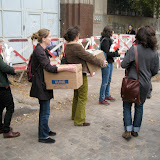
Alice Moscoso (NYU Libraries) & Andrés Insaurralde (Museo del Cine) research a 1923 documentary shot in Buenos Aires. Photo by Katy Martin.

Gentle reader:
Just a gentle reminder that June is the month when many of the proposals to present at the April 2010 symposium roll in. Please consider submitting if you have an interesting orphan film to screen, new preservation to unveil, a provocative paper on some neglected moving image history, or your own new media creation featuring same. Initial review of proposals begins in earnest at the end of June (though we still consider propositions made after).
In the last 48 hours alone, proposals arrived about
• a rediscovered Russian-Georgian silent film;
• a Rhodesian propaganda short from 1978;
• home movies shot at a women's college in China throughout the 1930s;
• 1923 amateur travel film of Japan, the Philippines, India, and Egypt;
• silent-era newsreel outtakes shot in Corsica and Formosa;
• an MPPDA-funded compilation film about American history (as enacted in Hollywood period pieces);
• a West African expedition documentary;
• an Uruguayan semi-professional hybrid trick photography movie;
• Jamaican-produced tourism films;
• U.S. government films produced in Iran in the 1950s and 60s;
• and of course riches from Argentina and Ghana.
I'm not making this up! I imagined hearing about a diversity of orphan films documenting places around the world, taken from all kinds of vantage points and in many genres. But I didn't realize how eclectic and revelatory these initial proposals would be (and I didn't mention all of them here).
To propose, e-mail a one-page abstract to Dan.Streible@NYU.edu.
Provide a summation of the argument or points to be made. Describe any media to be projected (format, content, running time), its significance, and relevance to the theme ("Moving Pictures Around the World").
See www.NYU.edu/Orphans for more about the symposium.
Short screenings are more likely to be programmed than longer ones. Original formats more likely than lower-grade copies. And the Orphan Film Symposium likes presentations that shake-up the conventional formats, i.e. the conference-paper-read-aloud, and the stand-alone screening sans explication.
The symposium also can arrange for preservation or reformatting of some material. Inquire.
Even if you are not proposing or presenting, consider registering to attend. Seating will be limited to 250, so early notice of registration is recommended.