Jun 9, 2009

Call for Presentations

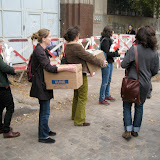
Alice Moscoso (NYU Libraries) & Andrés Insaurralde (Museo del Cine) research a 1923 documentary shot in Buenos Aires. Photo by Katy Martin.


Gentle reader:  

Just a gentle reminder that June is the month when many of the proposals to present at the April 2010 symposium roll in. Please consider submitting if you have an interesting orphan film to screen, new preservation to unveil, a provocative paper on some neglected moving image history, or your own new media creation featuring same.  Initial review of proposals begins in earnest at the end of June (though we still consider propositions made after). 

In the last 48 hours alone, proposals arrived about 

• a rediscovered Russian-Georgian silent film; 

• a Rhodesian propaganda short from 1978; 

• home movies shot at a women's college in China throughout the 1930s;  

• 1923 amateur travel film of Japan, the Philippines, India, and Egypt; 

• silent-era newsreel outtakes shot in Corsica and Formosa;

• an MPPDA-funded compilation film about American history (as enacted in Hollywood period pieces);

• a West African expedition documentary; 

• an Uruguayan semi-professional hybrid trick photography movie; 

• Jamaican-produced tourism films;

• U.S. government films produced in Iran in the 1950s and 60s;

• and of course riches from Argentina and Ghana.  


I'm not making this up!  I imagined hearing about a diversity of orphan films documenting places around the world, taken from all kinds of vantage points and in many genres.  But I didn't realize how eclectic and revelatory these initial proposals would be (and I didn't mention all of them here).  

To propose, e-mail a one-page abstract to Dan.Streible@NYU.edu.  

Provide a summation of the argument or points to be made. Describe any media to be projected (format, content, running time), its significance, and relevance to the theme ("Moving Pictures Around the World").  

See www.NYU.edu/Orphans for more about the symposium.

Short screenings are more likely to be programmed than longer ones. Original formats more likely than lower-grade copies.   And the Orphan Film Symposium likes presentations that shake-up the conventional formats, i.e. the conference-paper-read-aloud, and the stand-alone screening sans explication.  

The symposium also can arrange for preservation or reformatting of some material. Inquire.


Even if you are not proposing or presenting, consider registering to attend.  Seating will be limited to 250, so early notice of registration is recommended.

Jun 5, 2009

faces of the Museo del Cine


Katy Martin took this handsome photo of the Museo staff with the orphanistas estadounidenses. Although it was late autumn, the day was summer-warm. Hence the shine on some of the faces.


Moving pictures from APEX Ghana

The NYU Audio-Visual Preservation Exchange (APEX) that Professor Mona Jimenez launched last year began with partnerships in Ghana. While the Orphan Film Symposium group was in Buenos Aires, Mona was in Accra, with Kara Van Malssen (NYU Fellow; MIAP '06), Jennifer Blaylock (MIAP '10), Mick Newnham (NFSA Australia), and Ishumael Zinyengere (archivist for the Tanzania-based International Criminal Tribunal for Rwanda). This was the second year in a row that Mona and Kara have gone to Ghana to give archival training workshops.

The Ghana group has a similarly successful trip to report.

KaraVan has posted her first batch of photographs.

http://www.flickr.com/photos/karavan/sets/72157619172736295/

Beautiful images.


Photo by Kara Van Malssen.

Jun 2, 2009

fotografías del museo

Photo documentation of May 18, 2009, the orphanista tour of the Museo del Cine de Buenos Aires.


Click to see all 132 slides.

MuseoDay1

May 28, 2009

Bill Brand's report from Uruguay

On May 28, 2009 at 6:09 PM, Bill Brand wrote from MVD:

Hi Dan, 

Our visit here continues what we were doing in Buenos Aires.  We are advising on archives much more resource and information starved than the Museo del Cine.  Mostly, we're seeing personal home movie collections in 8mm & Super 8 but also 16mm.  At our workshop we demonstrated inspection, cleaning and repair -- of course without film cement or a tape splicer.

The Uruguayan desire to preserve or recover their visual history is driven by the disruption of their historical memory from the dictatorship and by the fact of a fire in the national film archive that destroyed their largest moving image collection.  The people here are embarking on a project to try to retrieve, reconstruct and resume their archive.  This includes information and memory of Latin America's first and longest running experimental film festival starting in the late 1940s and continuing into the 60s or 70s before the dictatorship.

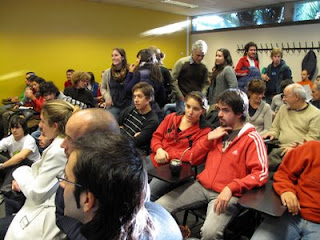
Later in the afternoon Katy and I  presented a program of our films and videos at the Catholic University.  People in the audience were texting friends to come quickly and eventually they couldn't fit in the room.  There must have been over 75 people.  The interest was very intense and many of the questions were technical in nature.  In attendance were students, faculty, artists, curators, and people from the national film archives and  SODRE's Archivo Nacional de la Imagen. [SODRE = Servicio Oficial de Difusión Radiotelevision y Espectáculos]

The demand for los archiveros sin fronteras is quite overwhelming!!!

Here's a link to pictures from the workshop:  http://facmvd.blogspot.com/


Here are some jpgs from the show. (Fotos de Katy Martin)


Bill Brand 
www.bboptics.com


orphanistas en el Museo del Cine de Buenos Aires
http://www.youtube.com/watch?v=nt3jPU24AiY


las orphanistas en el Museo del Cine de Buenos Aires (rough cut)

May 18-22, 2009.
17 orphanistas -- some from the Museo del Cinema staff, some from the visiting delegation (los archiveros sin fronteras) -- answering la pregunta "¿Cómo se llama?"


URL
http://www.youtube.com/watch?v=nt3jPU24AiY

May 24, 2009

sábado @ MALBA

Museum of Latin American Art of Buenos Aires 


As a special favor, Fernando Peña projected some rarities from private collections. The main attraction was a set of amateur films shot in 1930 by an aristocratic family in Buenos Aires. Fernando set up a 9.5mm projector in the booth and projected some of the footage onto the big screen.  (Certainly the largest 9.5mm image I've seen.)  


Along with portraits of the filmmaker's wife and daughters, there were extensive scenes of a group of men golfing and a sequence of the landing and departure of a very large German zeppelin.  But the most significant footage was in scenes shot at the time of Argentina's first military coup. The filmmaker was obviously an admirer and intimate of the fascist junta. His camera gains close access to the car parading the victorious generals and takes informal portaits of soldiers happily greeting the filmmaker on the day of the coup.  We see a few Mussolinist full arm salutes.  


The film has intertitles and even an animated closing title card (paint on glass spellling F-I-N), superimposed over a long shot of the Plaza del Mayo. An additional reel shows the victory parade, replete with heavy artillery on display, the following day.  


Fernando told us that a local collector acquired these 9.5mm films among a larger lot of materials he purchased at an estate sale. All of the family members seen in the pictures, as well as the filmmaker-father, reportedly died in a single car crash six years after the films were taken. Hence, orphan films in a tragically literal sense.  

hindsightƒ