Dec 21, 2012

more about the 2012 National Film Registry

A post-script to yesterday's post:

CBS News online has a nice gallery with images from each of the 25 titles on the 2012 Registry, as well as some stills about film preservation.  This was the only source Google image search found for an image from Parable.

CBS News also has like galleries from 2010 and 2011.

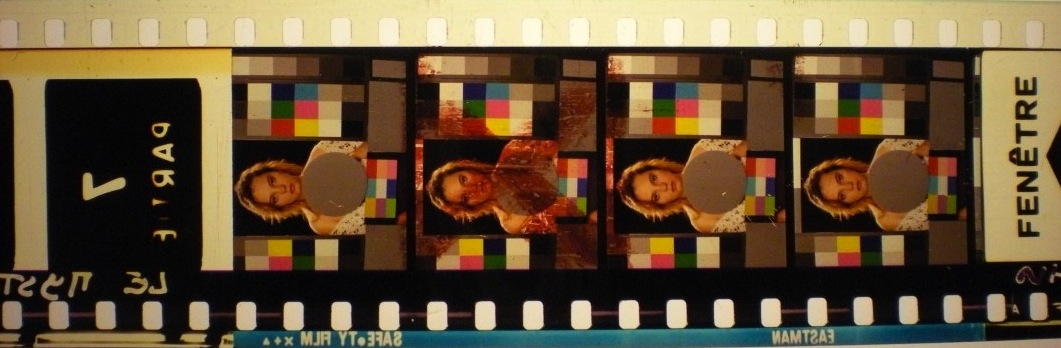
a frame grab from Parable (1964).  Rumors of this film presenting "Jesus as a clown" were obviously exaggerated. 


Dec 20, 2012

About PARABLE: Watch Mark Quigley's interview with Rolf Forsberg.

Guest blogger Mark Quigley is Manager of the UCLA Film & Television Archive's Archival Research and Study Center, who modestly describes himself as an "access archivist." As an adjunct faculty member, he teaches in UCLA's Moving Image Archive Studies master's program.  


------------------------------------------------------
Born in 1925, Rolf Forsberg began his career in the arts as a playwright and director in the Chicago theatre scene. (He was married to Second City improv master, Josephine Forsberg from 1945 to 1965). As a filmmaker, Rolf has written and directed dozens of productions, most notably, a number of innovative sponsored religious films, including Antkeeper (1966) and Stalked (1969; featured by archivist Skip Elsheimer on his “A/V Geeks Educational Archive Religion" DVD).  Rolf also co-directed the 1979 feature documentary, The Late Great Planet Earth, narrated by Orson Welles. Rolf is still working today, writing documentaries about the U.S. National Parks.

Parable (1964) made Rolf’s career as a writer/producer/director of sponsored films. Commissioned by the New York City Protestant Council of Churches for their 1964 World's Fair pavilion, the short film with a European art house feel was controversial, daring to use allegory in depicting “Christ as a clown.” Despite threats of violence and protests from numerous factions -- including objections from Robert Moses, president of the New York World’s Fair -- audiences embraced the strange, powerful short, with Newsweek calling Parable “very probably the best film of the fair.” Parable remained controversial, making local headlines in 1971 for its temporary removal from the Los Angeles Library system for promoting, “anti-establishment type things.” The film ultimately became a best seller in the religious 16mm market, successfully meeting the church’s aim of reaching secular audiences, and paving the way for Rolf’s hire on many subsequent film experiments to be funded by church organizations.

Watch Rolf Forsberg talk about Parable. (5:53)


Orphan films beget Orphan films.

In 2003, the UCLA Film & Television Archive acquired nearly the entire run of the ambitious religious TV anthology series, Insight (1960-1983), which also enjoyed distribution on 16mm to classrooms and churches. In 2006, I received a call from writer Paul Cullum, who was looking for a disturbing religious film (a dystopian take on government food assistance) that he had seen as a teen in Sunday school.  We both thought it was likely an Insight episode, but after much research it turned out to be a 1971 Lutheran short titled, And Then They Forgot God, made for the production company, Family Films. Our search for that obscure film is chronicled in the Dan Streible-edited Orphan Film issue of The Moving Image, vol. 9, no. 1, (Spring 2009).

Through that deep research, we came upon a fortuitous red herring -- recurring references to “Rolf Forsberg” as a “maker of odd religious films.” After tracking Rolf first in Chicago, and my later meeting with him in California, the UCLA Film & Television Archive became home to a number of Rolf's personal prints of his films. Our continued interest in Rolf's complex body of work, which is simultaneously surprisingly secular, expressionistic, and independent, has led to an extended dialog with the kind filmmaker, including a few rounds of an informal oral history (on digital video as well as good ol' audio cassette) and an even greater number of extremely enjoyable Sunday get-togethers for sharp reminiscences of a golden career. 

Thanks to Dan Streible and the Orphan Film Project for creating and nurturing a dynamic forum where talents such as Rolf Forsberg are embraced for rediscovery and reaffirmation.  Earlier this year, the "Orphans 8" symposium at Museum of the Moving Image featured a brief overview of Rolf's sponsored films, including a screening his provocative classic, One Friday (1973), which imagines an all-out race war. From that Orphans exposure came a BAMcinématek screening of Rolf's prescient ecological film Ark (1970), which played before Douglas Trumbull's partially Ark-inspired Silent Running (1972).

This momentum, of course, has now culminated with the Librarian of Congress naming Rolf's Parable to the 2012 National Film Registry.

-- Mark Quigley

* * * * * * * *

Primary documents, from the Times of New York (1964) and Los Angeles (1971).


Sharyn Elise Jackson's 2004 NYU honors thesis "International Participation in the New York World's Fair 1964-1965," mentions Parable. 


* * * * * * * * 


Q: HOW DO I PURCHASE A DVD?
A:  Parable is available from EcuFilm (United Methodist Communications) for $44.95. 
www.ecufilm.org, (888) 346-3862

Worldcat.org's record for Parable documents libraries holding it in 16mm, VHS, and DVD versions. Here's one library record, for the DVD. 
Parable [videorecording] / The Protestant Council of the City of New York
written by Rolf Forsberg; produced by Fred A. Niles; directed by Tom Rook, Rolf Forsberg.  Produced by the Council of Churches of the City of New York"--Back cover
Originally released as a motion picture in 1964.
--> Filmed with the cooperation of Circus World Museum, Baraboo, Wisconsin.[Nashville, Tenn.] : United Methodist Communications: EcuFilm, [2005?].
(22 min.) : sd., col. ; + 1 leaders guide (11 p. ; 18 cm.)

Announcement of the video availability of Parable came in a 2004 press release. 

For some reason the record's item summary and subject listing are in French. 
Pantomime mettant en scène un clown qui prend la place des exploités dans une troupe de cirque. Bande sonore originale.
Subject: Morale pratique.
The leader's guide is available for free download at the United Methodist Communications web store. The catalog description reads: 
A timeless classic of service and self-sacrifice, Parable was the groundbreaking, award-winning film that astounded crowds at the 1964 New York World’s Fair. Using only strong visual images and music, Parable continues to speak volumes to contemporary audiences about compassion, combating injustice, and selfless giving. Simple. Direct. Sure to affect any age or ethnic group and spark endless discussion. This is one film that your class will remember for years to come. Free guides are available for each title under the Free Study Guide section. Council of Churches of the City of New York.
Audience: Youth and adults
Suggested Settings: Sunday school, retreats, youth groups

The leader's guide also suggests showing the film to an audience either twice, or with "interrupted viewing" for discussion.  Another suggestion: "After a showing, you might leave the room darkened and comment: Let’s think for a moment about what we have seen...."  


Dec 19, 2012

PARABLE and other neglected films on National Film Registry

The Library of Congress today announced the 25 films added to National Film Registry for 2012.
www.loc.gov/today/pr/2012/12-226.html

Many in archiving, preservation, and orphan film circles are particularly amped about this year's list. Librarian of Congress James Billington, offered up a quite diverse set of American films, the most eclectic group of 25 in his 24 years of being the sole arbiter of all 600 titles now on the Registry.

Among those with an orphan or non-Hollywood status (15 as I count them), there are riches. So too among the Hollywood 10 (if I may). Classics enshrined on the Registry cover a variety of genres and eras. "Just in time for Christmas," the LOC gives us the boomer touchstone A Christmas Story (1983), followed by the Delmer Daves-directed Western drama 3:10 to Yuma (1957), the iconic Siegel-Eastwood cop drama Dirty Harry (1971), a George Cukor comedy remembered as Judy Holliday's best, Born Yesterday (1950), a Blake Edwards comedy absolutely owned by Audrey Hepburn, Breakfast at Tiffany’s (1961; map the novella and movie here!), the Penny Marshall-directed comedy best remembered for a man's line (Tom Hanks: "There's no crying in baseball!"), A League of Their Own (1992), a William Seiter-directed Hal Roach comedy starring Laurel & Hardy, Sons of the Desert (1933), and the franchise/zeitgeist movie about which nothing more need be said here because it's all around us all the time, The Matrix (1999).

Add to the Hollywood-distributed titles two features we might call "independent" in today's sense. Otto Preminger, truly a trouble-making independent supported by the studio system, made Anatomy of a Murder (1959), with a Duke Ellington score, Saul Bass titles (great poster!), and a cast of big name actors. The New Yorker published Lillian Ross's long and memorable profile of Preminger in 1966, when he was suing distributor Columbia Pictures and Screen Gems for -- get this -- cutting up his 160-minute movie so that commercials could be inserted during television broadcasts of Anatomy of a Murder! Much lower down the fiscal chain of command comes Monte Hellman's low-budget ($800,000) road movie cum cult picture, Two-Lane Blacktop (1971). Our leading men? James Taylor and Beach Boy Dennis Wilson! -- who don't play music, sing, or score the film! Shot on stretches of Route 66, from California to Tennessee, it works on a time-capsule level as well. 
AND it's about to be released on BluRay by Criterion.  See also "Ten (sixteen, actually) Reasons I Love Two-Lane Blacktop," by Richard Linklater, another 2012 Registry honoree.


The 15 other films are a great gumbo.

Of the silent-era picks, the entry listed as The Corbett-Fitzsimmons Title [sic] Fight (1897) is by far the oldest. I don't know how the stray word Title got into the Library of Congress press release. But there it is. And so more than 2,000 websites have already repeated this little error. The Veriscope Company's moving-picture recording of the heavyweight prizefight between Jame J. Corbett and challenger Robert Fitzsimmons is not exactly an unknown film in histories in cinema -- where it is conventionally known as The Corbett-Fitzsimmons Fight everywhere from Wikipedia to the Internet Movie Database. Actually, there was no official title for the work, so far as I know. No copyright record exists (although the Veriscope Company claimed to have filed for copyright. And there was likely no on-screen title printed into the celluloid in 1897. Newspaper ads used varying descriptive titles.

Thanks: Daniel Dempsey.
In terms of preserving the Veriscope film, the BFI's National Film and Television Archive and the Museum of Modern Art have preserved copies on 35mm, but neither is anywhere close to complete. Fight film collectors Jim Jacobs and William Cayton's salvaged the knockout portion of the recording from a brittle print in their Big Fights, Inc. collection (sold to ESPN/ABC).

Other fragments of The Corbett-Fitzsimmons Fight exist elsewhere. Just this year I received a note from someone who found his father owned a six-frame clipping of an original print.

As you can see from this scan the collector sent, the image was of an unconventional dimension. The film stock was 63mm wide (rather than 35mm) and the wider aspect ratio about 1.66:1 (rather than 1.33:1). All told, Enoch Rector's ability to capture the entire event -- 14 three-minute rounds with one-minute breaks, plus action before and after the bout -- on his unique format was unprecedented. Three cameras were said to have exposed some 10,000 feet of film. The Corbett-Fitzsimmons Fight was the only film made using this technology. The investors made a fortune on the roadshow exhibition and left the show business.

There's more about this in my book Fight Pictures: A History of Boxing and Early Cinema (2008). Corbett-Fitz gets its own chapter.

Grant Lobban (www.in70mm.com)
offers this detail:    
In 1983 the National Film Archive undertook the task of copying the original 63mm footage onto 35mm film. Using some material available from their archives together with extra reels provided by Jim Jacobs.... [The NFA] rephotographed the positive print cartoon style using a light box and register pins. Each frame being advanced by hand. The final 35mm print was of the masked frame type with an aspect ratio of about l,66:1 with the normal space being provided for a future sound track. . . [T]he fight film had also been copied by Karl Malkames Inc. in New York. In this case the printing was done using a special variable-pitch printer movement designed by Karl Malkames A.S.C. The final copy negative had a larger image extending the full width between the perforations.

The other silent movies on the 2012 Registry are from 1914: Uncle Tom's Cabin and Maurice Tourneur's The Wishing Ring. This version of the Harriet Beecher Stowe story was no doubt selected to stand on the Registry for the many film adaptations of what was 19th-century America's most popular theatrical production. Sam Lucas, who plays Uncle Tom, was the first African American actor to perform the role on film, and had been the first on stage as well. This arguably also made him the first black actor to play the lead role in a feature film. I've not seen The Wishing Ring, but it's an idyll of old England filmed in Fort Lee, New Jersey, by a newly arrived (and talented) French director.

Both 1914 films came from the new producer-distributor World Film Corp., co-founded by William A. Brady. Brady also headed Shubert Pictures, which produced The Wishing Ring. I doubt the coincidence was noted before both were selected to the Registry. (Or is this a Brady conspiracy? For Mr. Brady was the showman who managed the ring/stage/screen career of Gentleman Jim Corbett, making him a principal in the production of The Corbett-Fitzsimmons Fight  too!) Perhaps we shouldn't be surprised to find William Aloysius Brady's fingerprints all over early cinema history. He was, after all, president of the National Association of the Motion Picture Industry from 1916 to 1921. In other words, Brady was the immediate predecessor of Will Hays, tsar of the Motion Picture Producers and Distributors Association (1922-1945).


In the next posting, we'll take up the un-Hollywood additions to the National Film Registry:

  • Kodachrome Color Motion Picture Tests (1922)
  • The Middleton Family at the New York World’s Fair (1939) Prelingeriana
  • The Kidnappers Foil  (1930s-1950s) an amazing legacy of itinerant productions
  • Parable (1964) religious allegory made for the World's Fair
  • They Call It Pro Football (1967) from NFL Films, whose founder died this year
  • The Spook Who Sat by the Door (1973, Ivan Dixon) wow!
  • Hours for Jerome: Parts 1 and 2 (1980-82) by maestro Nathaniel Dorsky
  • Samsara: Death and Rebirth in Cambodia (1990) Ellen Bruno's thesis documentary
  • Slacker (1991) Richard Linklater's low-low-budget indie that sparked a scene
  • One Survivor Remembers (1995) Oscar-winning documentary by Kary Antholis
  • The Times of Harvey Milk (1984) finally. . .


For now we can end with a tease:


Earlier this year, Mark Quigley (UCLA) and videographer Farzad Nikbakht recorded an interview with Rolf Forsberg, the veteran filmmaker responsible for the controversial but acclaimed Parable.


Nov 23, 2012

China Girls: The Unknown Faces of the Silver Screen


The Orphan Film Project and NYU Cinema Studies are cosponsoring this swell event at Anthology Film Archives, programmed by Genevieve Yue.  Join us!

Her notes from the Anthology Film Archives calendar:

The various faces of the “China girl,” sometimes called a “China doll” or “girl head,” have appeared in more films than any actress, though she is almost never seen, save for the fleeting glimpses an audience might catch at the end of a film reel.
Macalester.academia.edu/Yue
These images of a woman, demurely positioned next to color swatches, have appeared on the leader of every commercial manufactured film since the late 1920s and continue in limited use today. The China girl image is instrumental in determining exposure, image density, and color balance, forming a kind of cinematic unconscious. Her essential but often overlooked role in film history has also made her a compelling subject for experimental filmmakers variously examining issues of celluloid materiality, the behind-the-scenes workings of the film industry, and the often marginal role of women. In some cases, the China girl is no less than the enigmatic icon of a vanishing medium.


Two programs highlight nine experimental films using the China girl, as well as a talk by programmer Genevieve Yue, and a projection performance by Sandra Gibson and Luis Recoder. (May we also say that Sandra Gibson is a 2010 graduate of NYU's M.A. program in Moving Image Archiving and Preservation?)

Program 1    Thursday, November 29 at 6:45 pm   (ca. 80 minutes) all in 16mm

Owen Land, INSTITUTIONAL QUALITY (1969, 5 min)

Owen Land, FILM IN WHICH THERE APPEAR SPROCKET HOLES, EDGE LETTERING, DIRT PARTICLES, ETC. (1965/66, 5 min, silent)

Morgan Fisher, STANDARD GAUGE (1984, 35 min)

Michelle Silva, CHINA GIRLS (2006, 3 min)

Thomas Draschan and Stella Friedrichs, TO THE HAPPY FEW (2003, 5 min)

Brian Frye, NADJA (2000, 3 min)

Timoleon Wilkins, MM (1996, 8 min)

Mark Toscano, RELEASING HUMAN ENERGIES (2012, 5.5 min)


Program 2  Thursday, November 29 at 9:00 pm

“Blink and Burn: China Girls in Experimental Film”
A talk by Genevieve Yue
&
A SOURCEFUL OF SECRETS (2002/2012)
Projection performance by Sandra Gibson and Luis Recoder
Gibson & Recoder at Orphans 2008

–.


Illustration at top from "China Girls / Leader Ladies," web page created by Northwest Chicago Film Society

with images from Benjamin Tucker, Becka Hall, and Chicago Film Archives
including a moving image from CFA (16mm WINK)


See also

Julie Buck and Karin Segal's "Girls on Film" exhibition at Harvard
http://www.news.harvard.edu/gazette/2005/07.21/00-girls.html

Watch the Buck & Segal movie, GIRLS ON FILM (2005)
http://www.youtube.com/watch?v=-nVBDX3P5TY&feature=share&list=PL23EEA35BB2E06885 


Nov 4, 2012

post-Sandy media restoration at Eyebeam Center (aka go MIAP!)

Here’s a New York update after the destruction wrought by last week’s hurricane (too terrible to be named “Sandy”).

Executive summary? Students and alumni from NYU’s Moving Image Archiving and Preservation Program are doing great things, including volunteering in disaster recovery efforts.

As I type this, some are on the ground at the recently flooded facilities of Eyebeam Art + Technology Center, a New York-based not-for-profit organization.


Here’s a post-Sandy e-mail several of us in MIAP received after the first wave of salvage and rescue operations. It’s author also wrote a MIAP thesis entitled “Disaster Planning And Recovery: Post-Katrina Lessons For Mixed Media Collections” (2006).


Subject: Eyebeam restoration (aka go MIAP!)
On Sat, Nov 3, 2012 at 9:12 PM, Kara Van Malssen (kara@avpreserve) wrote:

Dear MIAP folks,

Thanks so much to those of you who have come out to help at Eyebeam the past two days. You've been really incredible. We would never have got so far without your ingenuity, knowledge, skill and dedication. This has been an amazing learning experience for me, so I hope it has been for you as well. Nothing like a disaster to give you a crash course in disaster recovery!

BUT, we are not done, and we could really use your talents again tomorrow [Sunday]! Mornings have been slow, so the more of you who can come in the morning (starting around 10:15), the better.

If someone can forward the info to the 1st years MIAP students, that would be super.

Howard, Mona, Dan, Alicia -- you should be proud of the 2nd years (oh and a few faculty and alumni too, including Josh R[anger], Erik P[iil], Chris L[acinak], Seth A[nderson], Walter F[orsberg].... Hope I haven't forgotten anyone; it's been a real whirlwind could of days). Unfortunately, I don't have a group pic, but I've attached a few shots of people in action. 
Erica Titkemeyer


Dan Erdman

Kristin MacDonough, Shira Peltzman, Walter Forsberg

Erik Piil
Hope everyone who I haven't talked to is doing ok!

Thanks again,

Kara

-----------------

On Sat, Nov 3, 2012 at 10:14 PM, Mona Jimenez, MIAP’s Acting Director, replied.

Wow!  Inspiring work, all!!  Forwarded to first years.
---------------


Mona’s message was followed by this:

On Sun, Nov 4, 2012 at 1:29 PM, (dan.streible@nyu) wrote:

Hi, Kara, Chris, Mona, Howard and Moving Image Archiving & Preservation heroes.

No reason not to shout this out to everyone.

This is just the most recent of many reasons I am so proud to be affiliated with the program and the individuals in it. Not only is your work inspiring because it is 'impactful' (as Jodie Foster said in Contact) but your works are continuing evidence of how freakin' HARD you work.

For those being introduced to this conversation, for the first time: the Subject line references the ongoing disaster-recovery actions being taken in New York by MIAP ally Chris Lacinak's AudioVisual Preservation Solutions with many MIAP alumni and student volunteers at the not-for-profit Eyebeam Art + Technology Center. For 3 or 4 days running now.

This volunteering of hard (skilled) labor by MIAP peeps is all the more laudable given how much MIAP students achieved the 4 previous weekends.


• Friday, October 5: NYU Cinema Studies Community Weekend – AMIA @ NYU game night; 
• Saturday, October 13: a student-generated Archiving the Arts conference at NYU Tisch; 
• Saturday, October 20: alums and students volunteer at Home Movie Day at the Museum of Modern Art; 
• Saturday, October 27: MIAP student-generated and co-hosted World Day for Audiovisual Heritage 2012 as part of the Museum of Modern Art's annual international film preservation festival, To Save and Project.

And of course the conference and the WDAVH event involved months of planning. 
None of this was done as course work per se. These are impactful[!] events conceived and executed by MIAP students and their recruited allies.

No doubt I am omitting other amazing acts of professionalism and generosity these people have achieved in the past month. And of course many of these people were themselves undergoing the hardships of the hurricane aftermath. (You might be aware that one of the current MIAP students lost nearly all of her worldly possessions due to the flooding in New Jersey -- yet she remains part of the volunteer cohort!)

Even as MIAP/Cinema Studies students-staff-faculty-alumni remain international leaders in the field's theoretical and intellectual development, they are obviously kicking ass in practice. Making the world better for the living and their future descendants.

Also: Get some rest, all y'all.

Your admirer,

Dan Streible
NYU | Tisch School of the Arts | Cinema Studies | Moving Image Archive and Preservation Program
www.nyu.edu/tisch/preservation

------------

Looking back at Facebook postings, it seems to have been MIAP alum Peter Oleksik (now a video conservator at MoMA) who contacted Marko Tandefelt (Eyebeam's Director of Technology and Research) to set the work in motion.


See more photos of Team Eyebeam at work:   http://www.facebook.com/AVPreserve

# # #

Oct 20, 2012

#HMD2012

Sep 18, 2012

Rob Byrne (SF Silent Film Festival) visits the NYU Orphan Film Symposium (2012)

On the eve of the 8th Orphan Film Symposium, NYU Cinema Studies MA student (and now alumna) Daphna Jaglom was testing our new HD camcorder, straight out of the box. When
film preservationist Rob Byrne (also president of the board of the San Francisco Silent Film Festival) stopped by the Film Study Center at 721 Broadway, we asked him to sit for an informal camera test. He graciously agreed and talked about his previous Orphan Film Symposium experience in 2010.


http://archive.org/details/8thOrphanFilmSymposium_april112012_video


Here's a clip downsized to 480p. 

Four minutes of unedited DV, recording a conversation among Dan Streible, Rob Byrne, and (off camera) Cinema Studies student Christopher Insignares.

Note that all of the video shot during the April 11-14, 2012 symposium that followed is available at the Orphan Film Symposium Collection on the Internet Archive.  http://archive.org/details/OrphanFilmSymposium

Getting all the DV files uploaded turned out to be not only labor intensive, but also a learning experience for several of us. At the time, not even the videophiles among us knew that the camera  --   a Canon VIXIA HF R20 -- saved its video files in the .MTS format. And few of the videophiles among us had dealt with MTS before.

What is MTS?  A high-definition MPEG-2 format in AVC (Advanced Video Codec), developed for HD camcorders by Sony and Panasonic. Turns out this Canon model uses it too. The image looks great, especially in this 1920 x 1080 dimension. However, most applications can not process MTS files. They had to be converted, in this case to MP4 files.  NYU MIAP students Jieun An and Kelly Haydon did the conversion, and uploaded several dozen pieces to the site.


Again, all of the "footage" (to use the film-inherited term) is unedited, but also available to download and use (under a Creative Commons Attribution Noncommercial license).


 ###


hindsightƒ